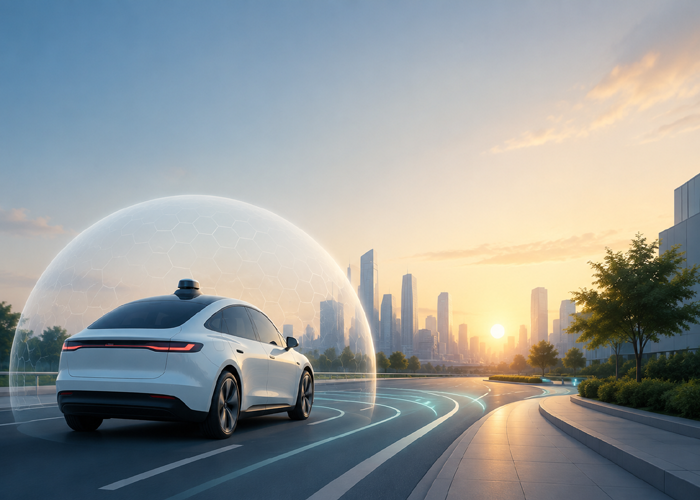
 Will Self-Driving Cars Ever Be Safe Enough for Everyday Use?
Imagine stepping into your car on a busy Monday morning. You don't touch the steering wheel. You don't check the mirrors. You don't even think about traffic. Instead, you sit back, answer emails, sip your coffee & arrive at your destination without ever driving.
For decades, this vision belonged to science fiction. Today, it is becoming reality.
Self-driving cars are no longer experimental machines hidden inside research facilities. They are being tested on public roads, navigating traffic, recognizing pedestrians, and making thousands of decisions every second. Automakers and technology companies are investing billions into autonomous driving systems, promising a future where accidents are rare, traffic flows efficiently & transportation becomes accessible to everyone.
Yet one question continues to dominate public discussions:
**Will self-driving cars ever be safe enough for everyday use?**
The answer is far more complex than a simple yes or no.
Safety is not just about technology. It is about trust. It is about ethics. It is about whether society is willing to hand over one of humanity's most common responsibilities—driving—to a machine.
The journey toward fully autonomous transportation is filled with extraordinary achievements, difficult challenges & important lessons about how humans interact with technology.
This article explores the future of self-driving vehicles, the safety concerns surrounding them & whether autonomous cars can eventually become safer than human drivers.
When people evaluate autonomous vehicles, they often expect perfection.
A self-driving car that makes one mistake quickly becomes headline news. Meanwhile, millions of mistakes made by human drivers every day receive little attention because they are considered normal.
This creates an interesting paradox.
Human drivers are not perfect.
People become distracted.
People become tired.
People become emotional.
People speed, text, drink & make poor decisions.
Even highly skilled drivers occasionally misjudge situations.
Every day, roads around the world witness collisions caused by simple human errors:
* Looking at a phone for two seconds
* Missing a stop sign
* Falling asleep at the wheel
* Driving aggressively
* Misjudging braking distance
The reality is that driving is an incredibly complicated task.
A driver must constantly process:
* Road conditions
* Traffic signals
* Vehicle speed
* Pedestrians
* Cyclists
* Weather changes
* Unexpected obstacles
Human brains perform these calculations naturally, but not flawlessly.
The true question therefore isn't:
**"Can self-driving cars become perfect?"**
The real question is:
**"Can self-driving cars become safer than humans?"**
That distinction changes everything.
Unlike humans, autonomous vehicles do not get distracted.
They do not become tired after long hours.
They do not drive under the influence.
They do not become impatient in traffic.
A self-driving system continuously monitors its environment using a combination of technologies such as:
* Cameras
* Radar sensors
* Advanced mapping systems
* Artificial intelligence
* Machine learning algorithms
These systems analyze enormous amounts of information simultaneously.
While a human driver may focus on one danger at a time, an autonomous vehicle can track multiple moving objects at once.
It can monitor:
* Vehicles ahead
* Vehicles behind
* Vehicles approaching intersections
* Pedestrians crossing streets
* Road markings
* Traffic lights
All in real time.
This capability represents one of the strongest arguments in favor of autonomous driving safety.
Machines can process information faster than humans.
However, processing information quickly does not automatically guarantee good decisions.
And that is where the challenge begins.
The Difference Between Seeing and Understanding
One of the greatest misconceptions about autonomous driving is that recognizing objects is enough.
In reality, driving requires interpretation.
Consider a simple example.
A child stands near the edge of a road.
A human driver immediately understands several possibilities:
* The child may run into traffic.
* A ball may follow.
* Another child could appear unexpectedly.
Humans naturally predict behavior.
Teaching machines to make similar predictions is significantly harder.
A self-driving vehicle may correctly identify:
"Object detected: child."
But understanding what that child might do next is a completely different challenge.
The road is full of unpredictable situations:
* Construction zones
* Temporary detours
* Emergency vehicles
* Aggressive drivers
* Unusual weather conditions
* Unexpected pedestrian behavior
Safe driving depends not only on recognizing the environment but also on anticipating uncertainty.
This remains one of the most difficult aspects of autonomous vehicle development.
Humans often underestimate how challenging weather can be for machines.
People naturally adapt to environmental conditions.
When heavy rain begins, drivers instinctively slow down.
When fog appears, drivers become more cautious.
When snow covers road markings, experienced drivers use context and judgment to navigate.
Autonomous systems must learn these same behaviors.
Unfortunately, weather can interfere with sensors.
Heavy rain may reduce visibility.
Snow can obscure lane markings.
Fog can distort camera images.
Sun glare can affect sensor accuracy.
Even something as simple as dirt on a camera lens can create complications.
For self-driving vehicles to become truly reliable, they must perform safely under conditions that challenge even experienced human drivers.
The technology is improving rapidly, but weather continues to represent one of the toughest real-world tests.
Technology is only part of the equation.
The larger challenge may actually be psychological.
People trust themselves.
Even if they are average drivers.
Even if statistics suggest otherwise.
Handing control to a machine feels uncomfortable because driving is deeply personal.
Most drivers believe they are capable of handling emergencies better than a computer.
This belief persists even when evidence suggests human judgment often fails under pressure.
Trust develops slowly.
Consider elevators.
When elevators were first introduced, many people feared them.
Passengers worried about mechanical failures & safety risks.
Today, millions enter elevators without hesitation.
The same transformation may eventually occur with autonomous vehicles.
But earning that trust will require years of consistent performance.
One highly publicized failure can significantly damage public confidence.
As a result, autonomous vehicle companies face a difficult challenge:
They must not only build safe technology.
They must convince society that it is safe.
One of the most debated topics surrounding self-driving cars involves ethics.
Imagine an unavoidable accident scenario.
Should the vehicle prioritize:
* Passenger safety?
* Pedestrian safety?
* Minimizing total harm?
Humans rarely think through these situations consciously.
In emergencies, drivers react instinctively.
Autonomous vehicles, however, rely on programmed decision-making.
This raises difficult questions.
Who decides how the vehicle should behave?
Engineers?
Governments?
Manufacturers?
Consumers?
There may never be universal agreement.
Different cultures may even have different expectations regarding acceptable risk and responsibility.
The ethical dimension of autonomous driving demonstrates that safety is not purely a technical challenge.
It is also a societal one.
Traditional vehicles face mechanical risks.
Autonomous vehicles face digital risks.
A self-driving car is essentially a computer on wheels.
That creates opportunities but also vulnerabilities.
Potential cybersecurity concerns include:
* Unauthorized access
* Software manipulation
* Communication interference
* Data breaches
Even if autonomous systems become exceptionally skilled drivers, they must also remain protected from digital threats.
Future transportation networks will likely involve communication between:
* Vehicles
* Infrastructure
* Traffic systems
* Navigation platforms
This interconnected environment offers tremendous benefits but requires strong security measures.
Safety in the autonomous era extends beyond crash prevention.
It includes protecting the entire digital ecosystem.
Many people imagine a future where all vehicles are autonomous.
However, the transition period may be far more complicated.
For decades, roads will likely contain a mixture of:
* Human drivers
* Semi-autonomous vehicles
* Fully autonomous vehicles
This creates unique challenges.
Human behavior is often unpredictable.
Drivers may:
* Ignore traffic rules
* Change lanes abruptly
* Make irrational decisions
Autonomous systems must coexist with this unpredictability.
Ironically, the safest future may emerge only after autonomous vehicles become widespread.
During the transition period, machines must adapt to human inconsistency.
That may prove more difficult than navigating roads filled entirely with autonomous vehicles.
Safety discussions often focus on accident prevention.
But autonomous vehicles could create another important benefit:
Mobility.
Millions of people face transportation barriers because they cannot drive safely.
These include:
* Older adults
* Individuals with visual impairments
* People with physical disabilities
* Individuals with certain medical conditions
Reliable self-driving transportation could dramatically improve independence and quality of life.
For many people, autonomous vehicles represent far more than convenience.
They represent opportunity.
They represent freedom.
This social impact is one reason autonomous driving continues to attract investment and research despite ongoing challenges.
One of the biggest misconceptions surrounding self-driving cars is that they must eliminate all accidents before becoming widely accepted.
That standard is unrealistic.
No transportation system is completely risk-free.
Airplanes remain among the safest forms of travel despite occasional incidents.
Elevators experience failures but remain trusted.
Medical procedures carry risks yet save countless lives.
The goal of autonomous driving is not perfection.
The goal is improvement.
If autonomous vehicles eventually reduce accidents dramatically compared to human drivers, society may view them as successful—even if isolated incidents still occur.
The future of transportation will likely be judged by overall safety outcomes rather than absolute perfection.
That shift in perspective is critical when evaluating autonomous technology.
Understanding the Levels of Self-Driving Technology
One reason many people are confused about autonomous vehicles is that not all self-driving systems are actually self-driving.
Modern vehicles exist on a spectrum of automation.
Some cars can maintain speed automatically.
Others can stay centered within lanes.
Some can park themselves.
A few can navigate complex traffic situations with minimal driver involvement.
The challenge is that these capabilities are often marketed in ways that make them sound more advanced than they truly are.
A vehicle that can assist with driving is not necessarily capable of replacing the driver.
This distinction matters because public expectations influence safety perceptions.
Many accidents involving advanced driver-assistance systems occur not because the technology failed completely, but because humans misunderstood its limitations.
The future of autonomous transportation depends not only on technological progress but also on clear communication.
Drivers must understand exactly what a vehicle can and cannot do.
Overconfidence can be just as dangerous as technical failure.
When people think about driving, they often focus on obvious tasks such as steering, braking & accelerating.
However, the true complexity of driving lies beneath the surface.
Every trip involves countless micro-decisions.
Should you slow down because a parked vehicle may pull into traffic?
Should you anticipate that a cyclist will move around a road obstacle?
Should you wait an extra second before entering an intersection?
Humans often make these decisions subconsciously.
Autonomous systems must learn to perform them intentionally.
The road environment contains endless variables:
* Different driving styles
* Unexpected weather
* Road construction
* Poorly marked lanes
* Temporary signs
* Unpredictable pedestrians
* Animals crossing roads
A system that performs flawlessly in one city may struggle in another.
Driving is not a fixed problem with fixed rules.
It is a constantly changing puzzle.
This explains why developing truly autonomous vehicles has taken longer than many experts initially predicted.
Despite these challenges, autonomous technology possesses one remarkable advantage.
Machines can learn from enormous amounts of data.
A human driver gains experience through personal journeys.
An autonomous system can learn from millions of journeys.
Every mile driven generates information.
Every traffic situation becomes a lesson.
Every unusual event contributes to future improvements.
Imagine a human driver instantly gaining the experience of millions of other drivers.
That is essentially what machine learning allows.
When one autonomous vehicle encounters a difficult scenario, the lessons learned can potentially improve an entire fleet.
This creates a unique cycle of continuous improvement.
The more autonomous vehicles operate, the more intelligent they become.
This collective learning process could eventually allow machines to outperform even highly experienced human drivers in many situations.
Most driving situations are relatively predictable.
Stopping at traffic lights.
Following traffic flow.
Changing lanes.
Maintaining safe distances.
The real challenge comes from rare events.
These situations occur infrequently but often carry significant risk.
Examples include:
* A mattress falling from a truck.
* A child chasing a ball into traffic.
* A traffic officer giving manual instructions.
* Flooded roadways.
* Animals suddenly entering the road.
* Infrastructure damage after a storm.
Humans rely on common sense and adaptability.
Machines must rely on training and decision models.
Preparing autonomous systems for every possible scenario is nearly impossible.
The world contains infinite variations of unexpected situations.
This is why autonomous vehicle developers place enormous emphasis on simulation testing.
Millions of virtual miles can expose systems to situations that might take decades to encounter naturally.
Still, the challenge remains.
Reality has a way of producing surprises no simulation anticipated.
In the past, testing a new vehicle required physical driving.
Today, autonomous systems can train in virtual environments.
These digital worlds recreate:
* Cities
* Highways
* Weather conditions
* Traffic patterns
* Pedestrian behavior
Developers can create dangerous situations safely & repeatedly.
For example:
A child running into traffic.
A sudden tire blowout.
A vehicle driving the wrong direction.
Heavy fog at an intersection.
Testing these scenarios in the real world would be risky and expensive.
Simulation allows engineers to expose AI systems to millions of difficult situations before they appear on public roads.
As computing power improves, these virtual environments become increasingly realistic.
This capability may become one of the most important tools in achieving autonomous safety.
Imagine a future where a self-driving car causes an accident.
Who is responsible?
The passenger?
The vehicle manufacturer?
The software developer?
The company providing mapping data?
Traditional traffic laws assume a human driver is responsible.
Autonomous vehicles challenge that assumption.
Governments around the world are still working to define legal frameworks that address these questions.
Without clear legal standards, widespread adoption becomes difficult.
Consumers need confidence.
Businesses need certainty.
Insurance companies need rules.
Regulators need accountability.
The future success of autonomous vehicles depends not only on engineering excellence but also on legal clarity.
Technology may move quickly.
Law often moves much more slowly.
The insurance industry may experience one of the biggest transformations in automotive history.
Today, insurance premiums largely reflect human behavior.
Factors include:
* Driving history
* Age
* Experience
* Traffic violations
If autonomous systems dramatically reduce accidents, traditional risk calculations may become less relevant.
Future insurance models could focus on:
* Software reliability
* System updates
* Vehicle hardware
* Cybersecurity protection
Responsibility may gradually shift from drivers toward technology providers.
This would represent a fundamental change in how transportation risk is managed.
Entire business models may evolve alongside autonomous technology.
Self-driving cars are often discussed as individual machines.
However, their greatest potential may emerge when they operate as part of a larger intelligent system.
Imagine a city where:
Traffic lights communicate with vehicles.
Road infrastructure provides real-time updates.
Construction zones automatically notify approaching cars.
Emergency vehicles coordinate traffic flow digitally.
Instead of reacting to conditions, autonomous vehicles could anticipate them.
Congestion might decrease.
Travel times could become more predictable.
Fuel consumption could decline.
Road safety could improve.
Smart cities and autonomous vehicles may develop together rather than independently.
The success of one may depend heavily on the success of the other.
Humans are emotional drivers.
People brake unnecessarily.
People hesitate.
People speed up aggressively.
People become distracted.
These behaviors create inefficiencies.
Traffic jams often emerge not because of physical obstacles but because of inconsistent human behavior.
Researchers have observed that small disruptions can create ripple effects through traffic systems.
One driver brakes suddenly.
Several vehicles behind react.
The result becomes a wave of congestion.
Autonomous vehicles could potentially smooth traffic flow by maintaining consistent speeds and spacing.
Even a relatively small percentage of autonomous vehicles on the road could improve overall traffic efficiency.
This benefit extends beyond convenience.
Smoother traffic often means safer traffic.
This question sits at the center of the autonomous vehicle debate.
Supporters argue that machines possess several advantages:
* Faster reaction times
* Continuous attention
* No fatigue
* No intoxication
* No emotional decision-making
Critics point to limitations:
* Lack of true human intuition
* Difficulty handling unusual situations
* Dependence on sensors
* Vulnerability to technical failures
The reality may lie somewhere in between.
Machines do not need to replicate human thinking perfectly.
They simply need to achieve safer outcomes.
History shows that technology often succeeds not by copying humans but by solving problems differently.
Airplanes do not fly like birds.
Calculators do not think like mathematicians.
Autonomous vehicles may ultimately become safer not because they drive like humans but because they drive in fundamentally different ways.
Technology adoption depends heavily on public confidence.
Many people remain skeptical of self-driving vehicles.
This skepticism is understandable.
Driving involves personal safety.
Trust develops slowly when lives are involved.
Interestingly, society often tolerates human mistakes more easily than machine mistakes.
A human-caused accident may be viewed as unfortunate.
A machine-caused accident may be viewed as evidence that the technology is flawed.
This creates a higher standard for autonomous systems.
To achieve widespread acceptance, autonomous vehicles may need to become significantly safer than human drivers—not just slightly safer.
Public perception will likely play a major role in determining the pace of adoption.
When people imagine self-driving technology, they usually think about personal cars.
However, some of the earliest large-scale benefits may appear elsewhere.
Potential applications include:
* Delivery vehicles
* Freight transportation
* Public transit
* Airport shuttles
* Industrial logistics
* Emergency response support
These controlled environments may provide valuable opportunities to refine autonomous systems.
Success in commercial applications could gradually increase public confidence.
The path toward fully autonomous personal vehicles may be built through success in other transportation sectors first.
Many futuristic predictions imagine a sudden transition.
One day humans drive.
The next day machines take over.
Reality rarely works that way.
The future will likely be gradual.
Vehicles may increasingly share responsibilities with drivers.
Automation may expand step by step.
Each improvement builds confidence.
Each success creates momentum.
Instead of replacing drivers overnight, autonomous systems may evolve through partnership.
Humans and machines will likely work together for many years before full autonomy becomes commonplace.
This gradual evolution may ultimately be the safest path forward.
Perhaps the most important question is not whether self-driving cars can become safe.
It is how society defines safety.
Is safety the complete elimination of accidents?
Is safety reducing risk below human levels?
Is safety creating transportation systems that save more lives overall?
Every transportation innovation has involved balancing benefits and risks.
The same will be true for autonomous vehicles.
As technology improves, the discussion may gradually shift from fear of machines to recognition of their potential.
The future of self-driving cars is not merely a technological story.
It is a story about trust, adaptation, and humanity's willingness to embrace a new way of moving through the world.




💬 Comment Section