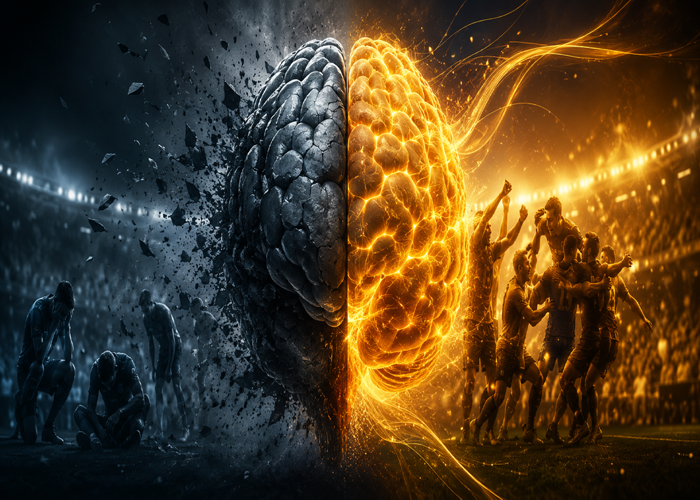
 The Psychology Behind Last-Minute Sports Comebacks
There is a strange moment that exists in every sport.
It happens when the scoreboard says one thing, but human beings begin to feel something completely different.
The numbers declare the game is almost over.
The crowd starts preparing explanations.
Commentators begin drafting conclusions.
Fans quietly lower their expectations.
Even the winning team starts imagining victory celebrations.
And then something changes.
A single goal.
A single basket.
A single defensive stop.
A single impossible play.
Suddenly the atmosphere bends.
The team that looked defeated begins moving differently. Their passes become sharper. Their bodies appear lighter. Their decisions become quicker.
At exactly the same moment, the team that seemed certain to win becomes hesitant.
The same athletes.
The same field.
The same rules.
The same score.
Yet the psychological universe of the game has completely transformed.
This phenomenon—the last-minute comeback—is one of the most fascinating events in sports because it reveals something profound about human psychology:
People do not respond to reality itself.
They respond to their perception of reality.
And perceptions can change in an instant.
Most people watch sports through the lens of physical performance.
They notice speed.
Strength.
Endurance.
Skill.
Technique.
But the most important game often happens in a place nobody can see.
Inside the minds of the athletes.
Every sporting contest is actually two competitions happening simultaneously.
The physical contest determines what is possible.
The psychological contest determines what becomes reality.
A team can be physically exhausted yet psychologically energized.
Another team can be physically dominant yet mentally collapsing.
The scoreboard only reveals the outcome.
It never reveals the internal battle that created it.
Late-game comebacks expose this hidden contest more clearly than any other moment in sports.
Because when physical fatigue reaches its highest level, psychology begins to matter even more.
The body gets tired.
The mind becomes louder.
And whatever voice wins that internal argument often wins the game.
Common logic suggests that teams should perform worse when they are trailing.
After all, they face more pressure.
Less time.
Greater urgency.
More mistakes should occur.
Yet history repeatedly shows the opposite.
Many teams become unexpectedly dangerous when they are close to defeat.
Why?
Because desperation changes attention.
When athletes believe they still have plenty of time, their minds wander.
They think about strategy.
They think about consequences.
They think about future plays.
They think about what might happen.
But when the clock becomes an enemy, the future disappears.
Only the present remains.
Athletes stop calculating.
They start reacting.
This creates a psychological state remarkably similar to what psychologists call complete task immersion.
Attention narrows.
Distractions fade.
Performance becomes instinctive.
The athlete stops thinking about the game and starts becoming part of it.
Ironically, the fear of running out of time can create the conditions for peak performance.
The athlete is no longer trying to avoid failure.
They are simply trying to survive the next moment.
And survival often unlocks abilities that comfort keeps hidden.
Ask any athlete about momentum and you'll receive a passionate answer.
Players swear they can feel it.
Fans swear they can see it.
Coaches swear it changes everything.
Yet momentum is difficult to measure.
You cannot weigh it.
You cannot record it.
You cannot put it on a scoreboard.
So why does it feel so real?
Because momentum is not primarily physical.
It is psychological.
Imagine two teams.
One team scores three times in rapid succession.
Objectively, only the score has changed.
Subjectively, everything has changed.
Confidence rises.
Fear shrinks.
Belief expands.
Decision-making accelerates.
Risk suddenly seems reasonable.
The brain begins constructing a new story.
Instead of thinking:
"We are losing."
Athletes begin thinking:
"We are coming back."
That subtle shift changes behavior.
And behavior changes outcomes.
Momentum is essentially a collective story spreading through an entire team.
The stronger the story becomes, the more players act as though success is inevitable.
And when enough people behave as if success is possible, impossible things start occurring.
One athlete can influence an entire team's psychology.
Not through talent alone.
Through emotional transmission.
Human beings are social creatures.
We constantly absorb emotional signals from others.
In sports, this process becomes amplified.
A captain who remains calm during crisis communicates information without speaking.
A star player who continues attacking despite failure sends a message.
A goalkeeper making an impossible save sends another.
Every action becomes psychological evidence.
Teammates unconsciously ask:
"What does this mean?"
And their brains immediately generate answers.
If a respected player appears confident, others borrow that confidence.
If a respected player appears defeated, others borrow that defeat.
This is why comebacks often begin with one person.
Not because one player physically changes everything.
Because one player changes what everyone else believes.
And belief spreads faster than strategy.
A coach may need ten minutes to explain a tactical adjustment.
An act of courage can inspire an entire team in three seconds.
Most discussions about comebacks focus on the team that recovers.
Few examine the team that collapses.
But understanding comebacks requires understanding both sides.
Because many miraculous recoveries are also psychological breakdowns.
When teams gain a comfortable lead, they often experience an invisible shift.
Their objective changes.
Instead of trying to win, they start trying not to lose.
That sounds similar.
It isn't.
Trying to win encourages action.
Trying not to lose encourages caution.
Trying to win focuses on opportunity.
Trying not to lose focuses on danger.
The brain processes these mindsets differently.
Athletes become less aggressive.
Less creative.
Less decisive.
The behaviors that built the lead slowly disappear.
This creates a paradox.
The closer victory gets, the more athletes think about protecting it.
And the more they think about protecting it, the more vulnerable it becomes.
Fear enters the system.
Not fear of failure.
Fear of losing something that already feels owned.
And that fear can be devastating.
A clock measures time.
The human brain experiences time.
These are completely different things.
Five minutes remaining in a tied game feels different from five minutes remaining when trailing by one point.
The number is identical.
The experience is not.
When athletes believe opportunity exists, time expands psychologically.
Every second feels valuable.
Every possession feels meaningful.
Every play feels alive.
When athletes believe defeat is approaching, time contracts.
Seconds disappear.
Decisions become rushed.
Panic accelerates perception.
This explains why successful comeback teams often speak about "slowing the game down."
They are not changing the clock.
They are changing their relationship with it.
They refuse to let urgency become panic.
They create psychological space inside physical pressure.
And that space allows better decisions.
The athletes who master pressure are rarely the fastest thinkers.
They are the calmest thinkers.
Fans often believe they merely observe games.
In reality, they participate.
Not physically.
Psychologically.
Crowds create emotional ecosystems.
Every cheer delivers information.
Every gasp delivers information.
Every silence delivers information.
Athletes constantly absorb these signals.
A roaring crowd can transform exhaustion into energy.
A nervous crowd can amplify uncertainty.
A hopeful crowd can create belief.
A frightened crowd can create doubt.
During comebacks, crowd psychology often changes before the scoreboard fully reflects it.
Fans sense possibility.
Athletes sense fans sensing possibility.
The emotional loop strengthens itself.
Energy circulates.
Confidence grows.
Pressure shifts.
What began as a sporting contest evolves into a shared psychological experience involving thousands of minds moving together.
The comeback becomes bigger than strategy.
It becomes collective belief in motion.
Most collapses do not happen all at once.
They begin with a tiny fracture.
A missed free throw.
A defensive error.
A dropped catch.
A careless turnover.
On their own, these moments appear insignificant.
But psychologically, they can be enormous.
Because humans are storytellers.
The brain constantly asks:
"What does this event mean?"
One mistake may mean nothing.
Two mistakes suggest concern.
Three mistakes begin creating a narrative.
Suddenly athletes stop focusing on execution.
They start focusing on interpretation.
The game is no longer about the next play.
It becomes about the story unfolding inside their heads.
And stories are powerful.
They shape attention.
They shape confidence.
They shape behavior.
Eventually they shape results.
Every historic comeback begins with a crack.
Not in the scoreboard.
In the narrative.
When Pressure Creates Greatness Instead of Panic
Most people assume pressure destroys performance.
It certainly can.
Athletes miss easy shots.
Quarterbacks throw interceptions.
Goalkeepers make uncharacteristic mistakes.
Champions suddenly look ordinary.
Yet sports history tells another story as well.
Some athletes seem to become stronger as pressure increases.
The louder the stadium becomes, the calmer they appear.
The bigger the moment becomes, the more precise their decisions become.
This raises an important question:
Why does pressure crush some athletes while elevating others?
The answer lies in how the brain interprets stress.
The human nervous system cannot always distinguish between danger & opportunity.
A racing heart can mean fear.
A racing heart can also mean excitement.
Sweaty palms can signal panic.
Or they can signal readiness.
The physical symptoms are often identical.
The interpretation is what matters.
Elite comeback athletes possess an unusual skill.
They reinterpret stress.
Instead of asking:
"What if we lose?"
They ask:
"What if this is our moment?"
That single shift changes everything.
The body produces energy.
The brain sharpens focus.
Attention narrows toward meaningful information.
Pressure stops feeling like a threat.
It begins feeling like fuel.
Athletes often describe extraordinary performances using surprisingly similar language.
They say things like:
"I wasn't thinking."
"The game slowed down."
"Everything felt automatic."
"It was like I was watching myself play."
These descriptions point toward a psychological phenomenon known as flow.
Flow is a state of total immersion where action and awareness merge.
The athlete stops consciously directing every movement.
Performance becomes instinctive.
Reaction becomes effortless.
The body seems to know what to do before the conscious mind catches up.
Many people imagine flow occurring only under perfect conditions.
A peaceful practice session.
A comfortable lead.
A stress-free environment.
But some of the most powerful flow states occur during chaos.
Why?
Because extreme situations eliminate distraction.
When a team faces imminent defeat, there is no room for irrelevant thoughts.
Bills don't matter.
Social media doesn't matter.
Tomorrow doesn't matter.
Only the next play matters.
Attention becomes laser-focused.
And under the right circumstances, that focus unlocks flow.
The comeback athlete isn't ignoring pressure.
They're absorbed by purpose.
And purpose often creates performance.
Every team has one.
The athlete who somehow smiles when everyone else looks terrified.
The player who requests the ball when others avoid responsibility.
The competitor who becomes energized by uncertainty.
These athletes aren't fearless.
Fear is universal.
What makes them different is their relationship with uncertainty.
Most people see uncertainty as danger.
Elite competitors often see uncertainty as possibility.
They understand something important:
A chaotic game is an unfinished story.
And unfinished stories can still be rewritten.
While others focus on what might go wrong, they focus on what might still happen.
This mindset creates psychological freedom.
They take smarter risks.
They remain aggressive.
They stay engaged.
And because they remain engaged, opportunities become visible.
Chaos doesn't guarantee success.
But athletes who embrace chaos are more likely to notice the doors that pressure opens.
Every comeback creates emotional turbulence.
The losing team experiences hope.
The winning team experiences anxiety.
Both emotions become stronger with each passing minute.
Imagine standing on opposite sides of a psychological earthquake.
One side feels the ground rising.
The other feels the ground shaking.
The score changes only slightly.
The emotional impact feels enormous.
Hope is one of the most powerful forces in sports.
Not because it guarantees success.
Because it changes effort.
People fight harder for outcomes they believe are possible.
A team down by twenty points may appear defeated.
A team down by ten points suddenly sees a path.
A team down by five points begins imagining victory.
As hope grows, effort grows.
As effort grows, performance often improves.
The scoreboard starts reflecting the emotional shift.
And the comeback gains momentum.
Many people think confidence comes from positive thinking.
In reality, confidence usually comes from remembered evidence.
The brain asks a simple question:
"Have we done something like this before?"
If the answer is yes, belief increases.
If the answer is no, doubt appears.
This explains why championship teams often produce dramatic comebacks.
They have accumulated psychological evidence.
They remember surviving difficult moments.
They remember overcoming deficits.
They remember proving people wrong.
Each memory becomes a mental resource.
A psychological savings account built through experience.
When crisis arrives, they withdraw from it.
Young teams often lack this advantage.
Veteran teams possess years of emotional data.
They have lived through storms.
And because they survived previous storms, current storms appear manageable.
Confidence isn't always arrogance.
Often it is memory.
Some teams develop a reputation.
Fans expect them to fight until the final whistle.
Opponents expect them to remain dangerous.
Commentators mention their resilience whenever they fall behind.
Over time, something fascinating happens.
The reputation becomes part of the team's identity.
And identity influences behavior.
People tend to act consistently with who they believe they are.
An athlete who sees themselves as resilient behaves differently during adversity.
A team that sees itself as relentless competes differently when trailing.
Identity becomes self-fulfilling.
When setbacks occur, these teams don't ask:
"Can we come back?"
They ask:
"How will we come back?"
Notice the difference.
The first question doubts possibility.
The second assumes it.
That assumption changes effort, focus & decision-making.
The comeback begins long before the scoreboard changes.
It begins inside identity.
The brain is not a passive observer.
It is a prediction machine.
Every second, it attempts to anticipate what happens next.
These predictions influence perception itself.
If athletes expect failure, they become more likely to notice evidence supporting failure.
If athletes expect success, they become more likely to notice opportunities.
This does not mean optimism magically creates victories.
Reality still matters.
Skill still matters.
Execution still matters.
But belief influences attention.
And attention influences performance.
A confident athlete notices openings.
A fearful athlete notices obstacles.
The field remains identical.
The experience becomes completely different.
During a comeback, belief reshapes perception.
And perception reshapes behavior.
The cycle feeds itself.
Thousands of games occur every year.
Most disappear from memory.
Yet people remember comebacks decades later.
Why?
Because comebacks satisfy something deeply human.
Human beings love transformation.
We love stories where outcomes change.
We love moments when certainty collapses.
We love evidence that circumstances are not destiny.
A comeback is more than a sporting event.
It is a narrative revolution.
The expected ending gets replaced.
The script gets rewritten.
The impossible becomes possible.
And for a brief moment, spectators experience something larger than entertainment.
They experience hope.
The reminder that situations can change.
That momentum can shift.
That failure is not final.
These lessons resonate far beyond sports.
When people discuss elite athletes, they usually focus on physical abilities.
Speed.
Power.
Technique.
Endurance.
Yet one of the most valuable skills receives far less attention.
Emotional regulation.
The ability to remain functional despite intense emotion.
Athletes cannot eliminate emotions.
Nobody can.
Fear appears.
Frustration appears.
Excitement appears.
Pressure appears.
The difference lies in response.
Average performers become controlled by emotions.
Elite performers learn to work alongside them.
They acknowledge anxiety without obeying it.
They feel pressure without surrendering to it.
They experience doubt without feeding it.
This emotional flexibility becomes priceless during comeback situations.
Because the game rarely rewards the athlete who feels best.
It rewards the athlete who functions best.
For most of a game, talent can hide weaknesses.
Superior skill can compensate for poor habits.
Athleticism can overcome mistakes.
But in the final moments, something else emerges.
Character.
Not character in the moral sense.
Character in the psychological sense.
The habits people rely upon when stress strips everything else away.
Pressure reveals what training has built.
Pressure reveals emotional discipline.
Pressure reveals resilience.
Pressure reveals belief.
When a comeback unfolds, we are not merely watching athletes perform.
We are watching identities collide.
One team chooses courage.
Another chooses caution.
One team embraces uncertainty.
Another fears it.
The scoreboard becomes a reflection of invisible decisions occurring inside dozens of minds simultaneously.
The reason sports comebacks fascinate us isn't because they are rare.
It's because they mirror life.
Everyone experiences deficits.
Everyone experiences setbacks.
Everyone experiences moments when the clock seems to be running out.
A career appears stalled.
A dream appears distant.
A relationship appears broken.
A goal appears unreachable.
In those moments, the mind begins telling stories.
Some stories create surrender.
Others create persistence.
The psychology of the comeback teaches a simple but profound lesson:
The situation matters.
But the interpretation of the situation matters too.
A deficit is not defeat.
A setback is not a conclusion.
A difficult chapter is not the final page.
The greatest comeback teams understand something many people forget.
The game is not over when things look bad.
The game is over when effort stops.
As long as effort remains alive, possibility remains alive.
And possibility has rewritten more scoreboards—and more lives—than anyone can count.
The most extraordinary thing about last-minute sports comebacks is not the athletic achievement.
It is the psychological achievement.
The ability to reject the evidence of the moment.
To believe in a different future before it exists.
To continue acting when success appears unlikely.
To remain committed while uncertainty grows.
This is the hidden power behind every great comeback.
Not talent alone.
Not strategy alone.
Not luck alone.
But the uniquely human capacity to imagine a better outcome and behave as though it is still possible.
Long before the scoreboard changes, the comeback begins in the mind.
And that is why these moments continue to captivate us.
Because every comeback is proof that the most powerful force in sports is not speed, strength or skill.
It is belief sustained under pressure.







💬 Comment Section