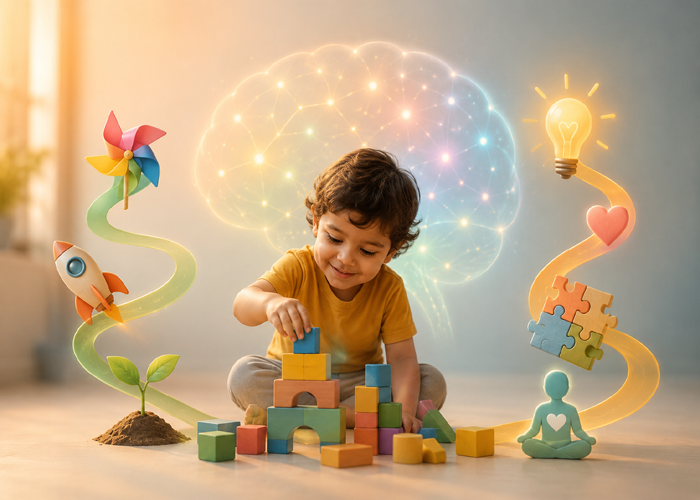
 How to Encourage Healthy Brain Development Through Everyday Play
Imagine for a moment that your baby has just discovered something extraordinary.
It isn't a new toy.
It isn't a colorful cartoon.
It isn't even a learning app.
It's a spoon.
The spoon clatters against the floor. Your child watches it fall. They hear the sound. They wait for your reaction. They bend down, pick it up, and drop it again.
And again.
And again.
To an adult, this looks repetitive.
To a developing brain, it looks like research.
Every day, children conduct thousands of tiny experiments. They test gravity, texture, sound, movement, emotions, language, relationships & cause-and-effect patterns. They do this not through worksheets or structured lessons but through play.
Modern parenting often creates pressure to optimize every moment. Parents search for educational toys, advanced learning methods & developmental milestones. Yet one of the most remarkable truths about childhood is surprisingly simple:
The brain grows best when children are allowed to play.
Not because play is a break from learning.
Because play is learning.
The Secret Work Happening Inside a Child's Brain
A child's brain is not an empty container waiting to be filled with information.
It is more like a living city under construction.
Roads are constantly being built.
Connections are being strengthened.
Unused pathways disappear.
New networks emerge every day.
Every laugh, every question, every block tower, every game of hide-and-seek contributes to this construction process.
When a child plays, multiple brain systems activate simultaneously.
Language centers process communication.
Memory systems store experiences.
Motor regions coordinate movement.
Emotional networks evaluate feelings.
Problem-solving circuits search for solutions.
Social systems learn cooperation.
Few activities activate so many areas at once.
This is why play remains one of the most effective developmental tools available—and it costs almost nothing.
Why Children Learn Best When They Don't Realize They're Learning
Adults often separate learning from enjoyment.
Children do the opposite.
When children enjoy something, attention naturally increases.
Attention fuels exploration.
Exploration creates discovery.
Discovery strengthens memory.
Memory builds intelligence.
Play creates a unique environment where learning happens organically.
Consider a toddler stacking blocks.
At first glance, they're simply building.
But beneath the surface, something much bigger is occurring.
They are learning:
* Balance
* Physics
* Spatial awareness
* Hand-eye coordination
* Patience
* Persistence
* Planning
* Creativity
* Cause and effect
All from a simple tower.
No lecture required.
No test necessary.
The lesson becomes part of their experience rather than something imposed upon them.
That difference matters.
Everyday Objects: The Hidden Brain-Building Tools Around Your Home
Many parents believe developmental growth requires expensive products.
Children disagree.
A cardboard box can become:
* A spaceship
* A castle
* A grocery store
* A race car
* A secret hideout
A wooden spoon becomes a drumstick.
A blanket becomes a tent.
A pillow becomes a mountain.
Children possess an extraordinary ability to transform ordinary objects into opportunities for learning.
This process develops one of the most valuable skills of all:
Imagination.
Imagination is not merely entertainment.
It trains the brain to see possibilities.
Every future inventor, entrepreneur, scientist, artist & leader relies on the ability to imagine something that does not yet exist.
That ability begins in childhood play.
The Language Explosion Hidden Inside Everyday Conversations
Many parents underestimate how powerful simple conversation can be.
A walk around the neighborhood can become a language-rich adventure.
Instead of saying:
"Look, a dog."
Try:
"That dog is running very fast. Where do you think it's going?"
Suddenly, vocabulary expands.
Observation increases.
Curiosity awakens.
Prediction skills develop.
Conversation is one of the most effective forms of cognitive play.
Children learn language not by memorizing words but by using them in meaningful situations.
The more interactive the discussion, the stronger the developmental impact.
Questions are especially powerful.
Children's brains love puzzles.
Every question invites the mind to search for answers.
That search strengthens thinking pathways.
Why Boredom Is Actually Good for the Brain
Modern childhood often leaves little room for boredom.
Screens fill quiet moments.
Schedules fill free time.
Entertainment appears instantly.
Yet boredom serves an important purpose.
Boredom forces creativity to wake up.
When external stimulation disappears, internal imagination takes over.
A child sitting quietly may soon begin:
* Creating stories
* Building worlds
* Inventing games
* Solving problems
* Exploring ideas
Many of humanity's greatest innovations began in moments that appeared unproductive.
For children, boredom often acts as a gateway to creativity.
Parents do not need to eliminate every moment of inactivity.
Sometimes the best developmental tool is simply space.
Movement: The Brain's Favorite Fuel
Children were not designed to sit still all day.
Movement directly supports brain development.
Running, jumping, climbing, balancing, dancing & spinning all provide valuable information to the nervous system.
Physical activity strengthens communication between different parts of the brain.
Movement also improves:
* Attention
* Memory
* Emotional regulation
* Coordination
* Decision-making
A child chasing bubbles is not merely exercising.
They are tracking movement.
Predicting trajectories.
Adjusting body position.
Processing visual information.
Making split-second decisions.
Physical play becomes cognitive training disguised as fun.
The Power of Pretend Play
A cardboard crown transforms a child into a king.
A blanket becomes a superhero cape.
A stuffed animal becomes a patient in a pretend hospital.
Adults often view these scenarios as make-believe.
The brain views them as advanced training exercises.
Pretend play develops:
Perspective Taking
Children learn to imagine another person's experience.
Emotional Intelligence
They experiment with different emotions safely.
Language Skills
They create dialogue and narratives.
Executive Function
They organize actions around a goal.
Creativity
They generate possibilities beyond reality.
Pretend play may appear simple, but it requires sophisticated mental processing.
In many ways, imagination becomes a rehearsal space for real life.
Why Mistakes Matter More Than Success
Parents naturally want children to succeed.
Yet brain development often grows fastest during failure.
Consider a puzzle.
If a child completes it immediately, little learning occurs.
If they struggle, experiment, adjust & finally succeed, the brain forms stronger connections.
Challenges create growth opportunities.
The goal is not to remove every obstacle.
The goal is to provide support while allowing children to think independently.
Play naturally creates this environment.
Games involve setbacks.
Blocks fall.
Towers collapse.
Plans fail.
Children learn resilience through these experiences.
And resilience is one of the most valuable lifelong skills.
Music: A Playground for the Brain
Music activates an astonishing number of brain regions simultaneously.
Children do not need formal lessons to benefit.
Simple activities can have a profound impact:
* Clapping rhythms
* Singing songs
* Dancing
* Making homemade instruments
* Playing musical games
Music supports:
* Memory
* Pattern recognition
* Listening skills
* Coordination
* Emotional awareness
Even simple nursery rhymes create rich developmental opportunities.
The combination of rhythm, repetition, movement & language creates a powerful learning experience.
Most importantly, children enjoy it.
And enjoyment strengthens engagement.
Nature: The Original Learning Environment
Before there were classrooms, there were forests.
Before educational apps, there were rivers.
Before interactive toys, there were rocks, leaves, insects & clouds.
Nature remains one of the richest environments for brain development.
A walk outdoors stimulates curiosity naturally.
Children notice:
* Shapes
* Colors
* Patterns
* Sounds
* Textures
* Movement
Nature also encourages open-ended exploration.
Unlike many toys with a specific purpose, natural environments invite discovery.
Every stick can become something different.
Every rock has a story.
Every puddle presents an experiment.
The unpredictability of nature keeps the brain engaged in ways that structured environments often cannot.
The Role of Emotional Safety in Learning
A child's brain learns best when it feels safe.
Fear narrows attention.
Stress limits exploration.
Security encourages curiosity.
When children feel supported, they are more willing to:
* Take risks
* Try new ideas
* Ask questions
* Solve problems
* Recover from mistakes
Play flourishes in emotionally safe environments.
A parent's smile, encouragement & presence often contribute more to development than any educational product.
Connection fuels confidence.
Confidence fuels exploration.
Exploration fuels learning.
And learning fuels growth.
Every Moment Counts
Parents sometimes worry they aren't doing enough
They wonder whether they should buy more educational materials.
Schedule more activities.
Teach more lessons.
Yet brain development is not built from occasional extraordinary experiences.
It grows through ordinary moments repeated consistently.
The conversation during breakfast.
The game before bedtime.
The walk around the block.
The pillow fort in the living room.
The silly dance in the kitchen.
The pretend tea party.
These moments may seem small.
But to a child's developing brain, they are everything.
Because the most powerful learning experiences often look exactly like play.
Many parents carry an invisible burden.
They believe every interaction must be educational.
Every activity must have a purpose.
Every toy should teach something.
Every moment should contribute to development.
The pressure can be exhausting.
Ironically, children do not need perfect parents to develop healthy brains.
They need present parents.
Brain development thrives through connection, consistency & meaningful interaction rather than perfection.
A child will not remember whether every activity was carefully planned.
They will remember how it felt to laugh with you.
To explore with you.
To feel safe with you.
These experiences become the foundation upon which future learning is built.
The healthiest learning environments often look surprisingly ordinary from the outside.
A family conversation.
A shared joke.
A game invented in the living room.
A walk after dinner.
What matters is not complexity.
What matters is engagement.
Why Curiosity Is More Valuable Than Knowledge
Imagine two children.
One knows many facts.
The other asks many questions.
Years later, which child is more likely to continue growing?
Knowledge is valuable.
Curiosity is transformative.
Knowledge fills the mind.
Curiosity expands it.
Healthy brain development depends heavily on curiosity because curiosity creates motivation.
When children become curious, the brain naturally seeks answers.
Attention increases.
Memory strengthens.
Learning becomes easier.
The challenge for parents is not teaching children everything.
The challenge is protecting their natural desire to discover.
This often means resisting the urge to immediately provide answers.
Instead of saying:
"Here's how it works."
Try asking:
"What do you think?"
This simple shift turns children from passive receivers into active thinkers.
And active thinkers build stronger cognitive skills.
One of the biggest misconceptions about child development is that learning requires special activities.
In reality, everyday routines offer countless opportunities for growth.
Grocery Shopping
A grocery store is a giant learning laboratory.
Children can:
* Compare sizes
* Count items
* Identify colors
* Learn new vocabulary
* Practice decision-making
Instead of rushing through the aisles, invite participation.
Ask questions.
Encourage observations.
Turn shopping into a scavenger hunt.
Suddenly, an ordinary errand becomes a cognitive workout.
Cooking Together
Cooking combines multiple developmental skills at once.
Children practice:
* Measuring
* Sequencing
* Following directions
* Problem-solving
* Fine motor control
They also learn patience.
Waiting for cookies to bake may be one of childhood's earliest lessons in delayed gratification.
Cleaning Up
Even cleanup offers developmental value.
Sorting toys strengthens categorization skills.
Organizing objects develops planning abilities.
Following routines builds executive function.
The brain is learning even when children don't realize it.
The Hidden Intelligence of Building Things
Children have an instinctive desire to construct.
Block towers.
Sandcastles.
Blanket forts.
Lego cities.
Cardboard creations.
Building activities activate several important brain systems simultaneously.
Children must visualize outcomes before they exist.
They must adapt when plans fail.
They must solve structural challenges.
They must persist through frustration.
Every creation begins as an idea.
Transforming ideas into reality strengthens cognitive flexibility.
The ability to imagine, plan & execute is a critical life skill.
And it often begins with a pile of blocks on the floor.
The Surprising Brain Benefits of Storytelling
Humans are storytelling creatures.
Long before children learn to read, they learn through stories.
Stories activate imagination in powerful ways.
Unlike passive entertainment, stories require children to create mental images.
The brain fills gaps.
Predicts outcomes.
Connects emotions.
Visualizes characters.
When children tell their own stories, the developmental benefits grow even stronger.
Encourage storytelling through:
* Puppet shows
* Pretend play
* Family conversations
* Drawing activities
* Bedtime imagination games
Ask questions such as:
"What happened next?"
"Why did the dragon feel sad?"
"How did the hero solve the problem?"
These conversations strengthen language, creativity & reasoning skills simultaneously.
Why Laughter Is a Powerful Learning Tool
Children learn best when they are emotionally engaged.
Laughter creates engagement naturally.
When children laugh:
* Stress decreases
* Attention improves
* Social bonds strengthen
* Positive emotions increase
A playful environment encourages exploration.
Children become more willing to try new things.
More willing to make mistakes.
More willing to experiment.
Many parents separate learning & fun.
Children often learn most effectively when the two happen together.
A silly game can sometimes teach more than a formal lesson.
Because emotions help memories stick.
The brain remembers experiences that feel meaningful.
Joy is meaningful.
The Importance of Open-Ended Play
Some toys tell children exactly what to do.
Press a button.
Watch a light flash.
Listen to a sound.
The interaction ends there.
Open-ended play works differently.
Open-ended materials include:
* Blocks
* Clay
* Cardboard
* Art supplies
* Blankets
* Loose parts
These materials have no single correct use.
Children must create the experience themselves.
This encourages:
* Innovation
* Problem-solving
* Independent thinking
* Creativity
The less a toy does, the more a child often does.
And that effort strengthens the brain.
Developing Attention in a Distracted World
Attention is becoming one of the most valuable cognitive skills of the modern era.
The ability to focus deeply impacts learning, relationships & future success.
Play helps develop attention naturally.
Consider a child building a complex structure.
They concentrate.
Adjust.
Evaluate.
Continue.
Minutes turn into hours.
This type of focused engagement strengthens attention networks within the brain.
Importantly, attention develops best through meaningful activities rather than forced concentration.
Children focus when they care.
Play gives them a reason to care.
Sensory Play: Feeding the Brain Through Experience
The brain learns by gathering information from the senses.
Touch.
Sight.
Sound.
Smell.
Taste.
Sensory play provides rich opportunities for exploration.
Examples include:
* Water play
* Sand play
* Finger painting
* Dough activities
* Nature exploration
Children compare textures.
Observe differences.
Notice patterns.
Experiment with cause & effect.
Sensory experiences help create stronger neural connections because multiple brain systems work together simultaneously.
The more meaningful the experience, the more memorable the learning.
Teaching Emotional Intelligence Through Play
Intelligence is not limited to academics.
Understanding emotions is equally important.
Children develop emotional intelligence through playful interactions.
Pretend games often involve feelings.
Characters become:
* Excited
* Frustrated
* Nervous
* Happy
* Brave
* Disappointed
Discussing these emotions helps children recognize them in real life.
Questions can include:
"How do you think the teddy bear feels?"
"What would help the puppy feel better?"
"What would you do if you felt that way?"
These conversations build empathy.
Empathy strengthens relationships.
Strong relationships support lifelong learning.
Everything connects.
The Brain Loves Challenges
Growth occurs when children encounter manageable difficulties.
Not tasks that are impossible.
Not tasks that are effortless.
Challenges that sit somewhere in the middle.
Play naturally provides this balance.
Children adjust difficulty levels on their own.
If a game becomes too easy, they add complexity.
If a challenge becomes overwhelming, they simplify it.
This self-adjustment keeps the brain engaged in the ideal learning zone.
Parents can support this process by encouraging persistence rather than immediately solving problems.
The goal is not to remove every struggle.
The goal is to help children develop confidence in their ability to overcome obstacles.
Friendship as a Brain-Building Experience
Play with others offers unique developmental benefits.
Social play teaches children to:
* Negotiate
* Cooperate
* Share
* Communicate
* Resolve conflicts
These skills require advanced brain processes.
Children must consider multiple perspectives.
Interpret social cues.
Adjust behavior.
Manage emotions.
Group play is essentially a real-world training ground for human interaction.
Every game becomes a lesson in communication.
Every disagreement becomes an opportunity to practice problem-solving.
Every friendship strengthens social intelligence.
The Long-Term Impact of Play
The value of play extends far beyond childhood.
The skills developed during playful experiences often shape adulthood.
Creativity becomes innovation.
Curiosity becomes lifelong learning.
Problem-solving becomes leadership.
Resilience becomes perseverance.
Communication becomes influence.
Confidence becomes independence.
The games children play today quietly prepare them for challenges they will face decades from now.
The connection is not always obvious.
But it is powerful.
Every fort built from blankets.
Every imaginary adventure.
Every conversation.
Every question.
Every experiment.
Every playful moment contributes another brick to the foundation of a growing mind.
And that foundation can support a lifetime of learning, adaptation & success.
In the next section, we'll explore advanced brain-building play strategies, age-specific activities, screen-time balance & practical ways parents can create a home environment that naturally encourages cognitive growth every single day.
Many parents imagine brain development as something they actively teach.
In reality, environment often teaches more than instruction.
Children absorb information from the spaces around them.
A home does not need to look like a classroom to support learning.
In fact, the most brain-friendly homes rarely do.
Instead, they offer opportunities for exploration.
They encourage questions.
They invite creativity.
They make discovery feel natural.
Think of your home as a launchpad rather than a lecture hall.
Children should feel free to investigate, create, build, imagine & experiment.
This doesn't require expensive furniture or educational equipment.
Often, the most valuable additions are surprisingly simple:
* Books within easy reach
* Art supplies available for spontaneous use
* Building materials
* Open floor space
* Nature items like rocks, leaves & shells
* Comfortable reading corners
These elements quietly encourage curiosity throughout the day.
The goal is not to fill every corner with stimulation.
The goal is to create an environment that inspires children to engage with the world.
Age-Specific Play for Brain Development
Every stage of childhood presents unique opportunities for growth.
The brain changes rapidly, and play evolves alongside it.
Infants (0–12 Months)
During the first year, the brain develops at an astonishing pace.
Simple interactions have tremendous value.
Effective activities include:
* Face-to-face conversations
* Singing songs
* Gentle movement games
* Peekaboo
* Exploring safe textures
* Looking at books together
At this stage, relationships are the most powerful developmental tool.
A loving interaction does far more than a complex toy.
Toddlers (1–3 Years)
Toddlers become explorers.
Everything becomes fascinating.
Everything becomes an experiment.
Brain-building play includes:
* Stacking objects
* Water play
* Simple puzzles
* Pretend cooking
* Dancing
* Outdoor exploration
The key is allowing safe independence.
Toddlers learn by doing.
Not by watching.
Preschoolers (3–5 Years)
Imagination begins to flourish.
Pretend worlds become increasingly sophisticated.
Activities that support development include:
* Role-playing games
* Story creation
* Building projects
* Art exploration
* Memory games
* Nature adventures
This stage is rich with creativity.
Protecting that creativity is incredibly important.
School-Age Children (6–12 Years)
Children become more interested in challenges.
Problem-solving abilities expand dramatically.
Effective play experiences include:
* Strategy games
* Construction projects
* Sports
* Science experiments
* Creative writing
* Team activities
The goal shifts from simple exploration to deeper thinking.
Children begin connecting ideas across different experiences.
Why Questions Matter More Than Answers
Many adults believe teaching means providing information.
Children often learn more when they search for information themselves.
Questions activate curiosity.
Curiosity activates learning.
Consider the difference between these two approaches:
"Birds migrate because of seasonal changes."
Versus:
"Why do you think birds leave during certain times of the year?"
The second approach engages the brain.
Children begin forming hypotheses.
Evaluating possibilities.
Testing ideas.
Even incorrect answers contribute to development because thinking itself strengthens cognitive pathways.
Questions transform children from consumers of knowledge into creators of understanding.
The Creativity Crisis Nobody Talks About
Young children naturally display extraordinary creativity.
Ask a five-year-old to invent a story.
They'll create entire worlds.
Ask them to imagine a new animal.
They'll combine features in unexpected ways.
Creativity often appears effortless.
Yet as children grow older, opportunities for creative thinking sometimes decrease.
Schedules become structured.
Answers become standardized.
Mistakes become discouraged.
The result?
Many children gradually become less willing to think creatively.
Everyday play protects creativity.
It gives children permission to explore possibilities without fear of being wrong.
Creativity is not limited to artists.
Scientists need creativity.
Entrepreneurs need creativity.
Engineers need creativity.
Doctors need creativity.
Problem-solvers need creativity.
The future belongs to people who can imagine solutions that don't yet exist.
Play develops that ability.
Why Free Play Deserves More Respect
Free play is often misunderstood.
Because it appears unstructured, adults sometimes assume little learning is happening.
The opposite is true.
Free play may be one of the most sophisticated developmental activities children engage in.
During free play, children:
* Set goals
* Create rules
* Solve problems
* Manage emotions
* Negotiate with others
* Adapt to challenges
No worksheet can replicate this complexity.
When children direct their own play, they practice independence.
They become decision-makers rather than followers.
This strengthens executive function, one of the brain's most important systems.
Executive function supports:
* Planning
* Self-control
* Organization
* Attention
* Decision-making
These skills influence success throughout life.
Screen Time and Brain Development
Technology has become a permanent part of modern childhood.
The question is not whether screens exist.
The question is how they are used.
Not all screen experiences are equal.
Passive consumption offers fewer developmental benefits than active engagement.
Brain development thrives through interaction.
Conversation.
Movement.
Problem-solving.
Exploration.
Screens become most beneficial when they complement these experiences rather than replace them.
For example:
Watching a nature documentary can inspire outdoor exploration.
Learning a song online can lead to dancing and singing.
A digital drawing tool can inspire creative expression.
Balance matters.
Children still need opportunities to touch, move, build, imagine & interact with real people.
The physical world remains the brain's richest classroom.
Encouraging Risk-Taking in Safe Ways
Every achievement begins with uncertainty.
Children need opportunities to take age-appropriate risks.
Not dangerous risks.
Developmental risks.
Trying something new.
Speaking up.
Building something difficult.
Attempting a challenging task.
Learning requires courage.
Play provides a safe environment to practice that courage.
When children climb a little higher, attempt a harder puzzle or invent a new game, they build confidence.
Confidence grows through experience.
Not through constant reassurance.
Children discover:
"I can do difficult things."
That belief becomes a powerful asset throughout life.
The Connection Between Play and Future Success
Success is often associated with intelligence.
Yet many successful adults share other qualities as well:
* Adaptability
* Creativity
* Persistence
* Communication
* Curiosity
These qualities are frequently developed through play.
A child building a fort practices planning.
A child inventing a game practices innovation.
A child solving a disagreement practices negotiation.
A child trying again after failure practices resilience.
Play develops the human skills that machines cannot easily replicate.
And those skills are becoming increasingly valuable.
How Parents Can Become Better Play Partners
Parents do not need special training to support development.
Small changes can make a big difference.
Follow the Child's Lead
Observe interests.
Join activities.
Allow curiosity to guide the experience.
Focus on Process
Praise effort.
Celebrate exploration.
Avoid focusing only on outcomes.
Ask Open-Ended Questions
Encourage thinking.
Invite imagination.
Support discussion.
Embrace Messes
Creativity is rarely tidy.
Exploration often creates temporary chaos.
Be Present
Attention is one of the most valuable gifts a parent can offer.
Children notice presence.
And presence strengthens connection.
The Invisible Lessons Hidden in Play
Many of the most important lessons children learn cannot be measured easily.
Play teaches:
How to recover from disappointment.
How to cooperate.
How to persist.
How to imagine.
How to lead.
How to follow.
How to communicate.
How to adapt.
These lessons become part of who children are.
Long after toys are forgotten.
Long after games end.
The experiences remain.
And those experiences shape the developing brain in profound ways.
A Future Built One Playful Moment at a Time
Parents often wonder whether they are doing enough.
Whether they are providing enough opportunities.
Whether they are supporting development effectively.
The answer is often closer than they realize.
Healthy brain development rarely depends on extraordinary moments.
It grows through ordinary experiences repeated consistently.
The bedtime story.
The backyard adventure.
The family board game.
The living room dance party.
The cardboard castle.
The endless questions.
The shared laughter.
These moments may appear simple.
But within them, countless neural connections are being formed.
Skills are emerging.
Confidence is growing.
Curiosity is expanding.
And a child's future is quietly taking shape.
The remarkable truth is that some of the most powerful brain-building activities don't look like education at all.
They look like play.
And that is exactly why they work.
Parenting advice has never been more abundant.
Open a social media app, browse parenting forums, or walk into a toy store & you'll encounter countless claims about what children supposedly need to become smarter, faster learners or more successful adults.
Some advice is useful.
Some is misleading.
And some creates unnecessary anxiety.
Let's clear away a few common myths.
Myth 01: Expensive Educational Toys Create Smarter Children
The marketing is persuasive.
Boxes promise accelerated learning.
Advertisements showcase impressive developmental claims.
Yet a child's brain does not measure the price tag of a toy.
It responds to engagement.
A cardboard box can inspire more creativity than an expensive electronic toy.
A pile of blankets can become a castle, spaceship, cave or pirate ship.
The value lies not in the object itself but in how the child interacts with it.
Myth 02: More Activities Mean Better Development
Many children today move from one organized activity to another.
Sports.
Classes.
Lessons.
Programs.
While structured activities have benefits, overscheduling can reduce opportunities for free exploration.
Children need time to think.
To imagine.
To invent.
To be bored.
Development requires both guidance and freedom.
Myth 03: Learning Must Look Academic
Parents often worry when children seem to be "just playing."
Yet play frequently contains advanced learning opportunities.
A child organizing toy animals may be practicing categorization.
A child building a tower may be exploring engineering principles.
A child pretending to run a store may be developing mathematical & social skills.
Learning often wears a disguise.
That disguise is called play.
Myth 04: Mistakes Should Be Prevented
Mistakes are not evidence of failure.
They are evidence of growth.
Every error provides feedback.
Every setback creates an opportunity to adapt.
Children who learn






💬 Comment Section